Understanding Peptide Pureness Testing
Air Conditioner Peptide Screening Labs Third-party Peptide Analysis
Explore our catalog to watch verified study substances and find out more concerning our testing and quality assurance procedure. Even small pollutants can change results, minimize reproducibility, or introduce undesirable variables into a study. Scientists depend on accurate, verified substances to ensure their searchings for are both valid and regular.Peptide Quality Testing Platform From Boc Scientific Researches
- Additionally, strategies such as amino acid analysis and HPLC are utilized to confirm the peptide's identification and purity, ensuring precise characterization for numerous applications.
- Call us today to review your peptide sequence, example condition, and analytical objectives.
- It works as a pointer and legal disclaimer that the item is not a restorative or palatable.
- Web peptide content refers to just how much real peptide (by weight) is in the vial about non-peptide components like water, counter-ions (e.g., TFA), or buffer salts.
- We sustain targeted analysis of pertinent residuals based upon the job and sample background.
The purity of peptides is normally evaluated making use of high-performance liquid chromatography (HPLC). HPLC separates peptides based on their interactions with a fixed phase, enabling impurities and by-products to be recognized and evaluated. Additionally, mass spectrometry (MS) can be made use of to confirm the peptide's molecular weight and sequence, providing additional confirmation of pureness by discovering impurities and destruction products. If you've ever obtained an artificial peptide for a laboratory experiment, you've most likely discovered a pureness percent on the certificate of evaluation-- commonly values like 95%, 98%, or even 99%. Peptide pureness is an essential top quality metric that tells you what fraction of a peptide example is the intended product versus unwanted byproducts.
While peptide purity isn't the only aspect, utilizing inadequately characterized reagents is an acknowledged factor to irreproducible results. For a 10-residue peptide with 99.5% combining performance, you 'd anticipate regarding 95% of the final product to be the full-length series prior to filtration. For a 30-residue peptide at the same performance, that drops to about 86%. This is why longer peptides are harder to produce at high purity and normally cost even more. Pureness is the percent of publications in the delivery that have every page printed correctly, in the right order, with no missing chapters and no added pages packed in. A 95% purity indicates that out of every 100 "books" in your set, 95 are best copies and 5 have some kind of error.Residuals Screening
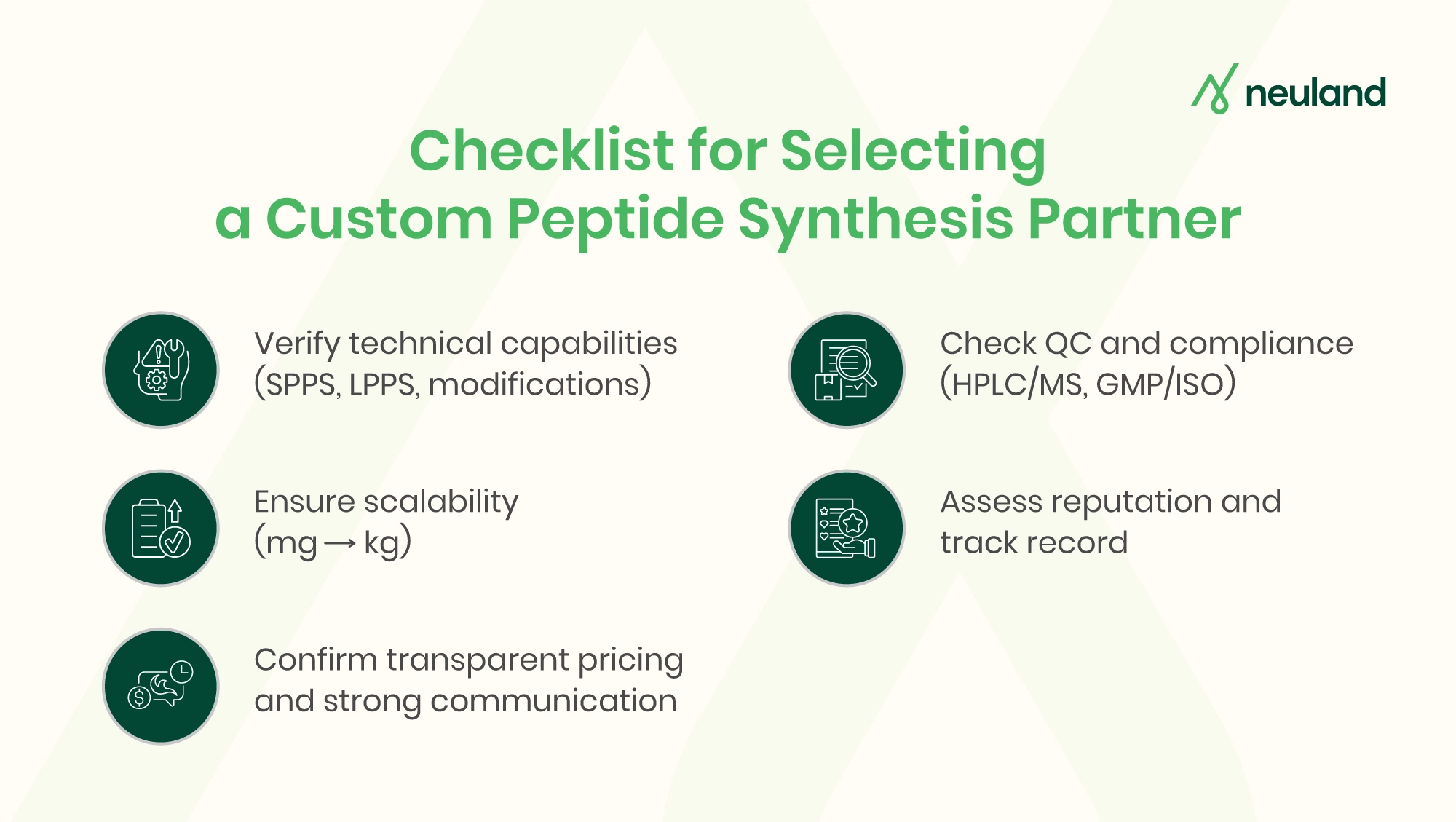
Respectable peptide vendors always mark their Research Grade Peptides items this way and provide quality records with HPLC and MS information to support the purity level. As long as you obtain peptides from a relied on resource that provides a full certificate of evaluation, you can be positive in the peptide's pureness quality and use range. Peptides are evaluated via a combination of strategies, including HPLC for pureness, mass spectrometry (MS) for series verification, and nuclear magnetic resonance (NMR) for structural evaluation. These techniques aid determine the peptide's composition, validate the molecular weight, and identify any type of architectural alterations or pollutants, making certain the peptide satisfies top quality and specification needs. With our thorough peptide evaluation platform, Imaginative Proteomics has actually developed a very delicate and customized platform.